
Building maintenance in Dubai: lessons from real UAE cases
Public fire, facade, cooling, water tank and lift cases from Dubai and the UAE, the maintenance lesson in each, and what to ask a building maintenance company.
About these cases
OMEGA does not yet publish case studies of its own building contracts. This guide uses public material instead: official statements, laws and guidelines, and reporting by Gulf News, Khaleej Times and The National. None of the buildings below is or was an OMEGA contract.
Each case sets out what was reported, with its date and source, the maintenance lesson, and what a building maintenance contract should include as a result. Where only preliminary findings exist, the guide says so, and it does not assign blame beyond what the authorities stated.
Some cases come from Sharjah and Abu Dhabi. The rules there differ in detail, but the equipment and the climate are the same, so the lessons carry across.
What the cases have in common
Few of these incidents begin with one dramatic failure. More often a system was not checked, a temporary repair became permanent, or no one planned for a part that takes weeks to arrive.
- Safety systems are only proven when they are tested. An alarm or detector that has not been checked is an unknown.
- Facades and external electrical fittings are out of sight, so they need a schedule, not a complaint, to be inspected.
- Critical plant such as chillers and pumps needs spares planning and a replacement plan, not only repairs.
- Records matter. Dubai’s water rules, the jointly owned property law and the 2026 building safety law all expect evidence of maintenance.
| Case | What was reported | Lesson for maintenance |
|---|---|---|
| Al Ras, Deira, April 2023 | A residential building fire killed 16 people. Dubai Civil Defence’s preliminary finding was non-compliance with safety requirements. | Test fire and life-safety systems on a schedule and keep the record. |
| The Torch, Dubai Marina, 2015 and 2017 | Two facade fires with no deaths reported. RERA later backed replacing potentially flammable facades. | Know what the facade is made of and inspect it on a schedule. |
| The Address Downtown, December 2015 | Dubai Police traced the fire to a short circuit in a spotlight’s cables. | Inspect external and common-area electrical fittings. |
| Al Nahda, Sharjah, April 2025 | Five people died. The initial finding was an overloaded transformer; earlier cladding removal helped limit the spread. | Watch electrical loads, and act on facade guidance early. |
| Chiller failures, 2015 to 2019 | Residents of two Dubai buildings went without proper cooling for more than a week, and in one tower for 43 days. | Plan spares, standby and replacement for central plant. |
| Record rain, April 2024 | The heaviest rainfall since UAE records began in 1949; residents later linked chiller faults to rain damage. | Check roofs, drains, pumps and electrical cabinets before the wet season. |
| Water tanks, Dubai Municipality rules | Tanks must be cleaned and disinfected at least twice a year by an approved company and inspected monthly. | Keep certificates and test results on file. |
| Lifts, Abu Dhabi, August 2026 | Civil Defence fines buildings without an approved lift maintenance contract Dh5,000. | Keep specialist contracts current before a breakdown. |
Case 1: Fire systems that are not tested
On 15 April 2023, a fire in a five-storey residential building in Al Ras, Deira, killed 16 people and injured nine, as reported by The National and Gulf News. Dubai Civil Defence said preliminary investigations showed that lack of compliance with building security and safety requirements caused the fire, and urged building owners and residents to comply fully with those requirements.
Evidence from elsewhere in the UAE shows how common the gap can be. In October 2018, the operations director of Hassantuk, the national smart fire alarm project, told Gulf News that of about 11,000 Abu Dhabi buildings surveyed, around 80 per cent needed repairs to fire alarm panels, detectors or connectivity before they could be connected. Hassantuk did not cover Dubai.
In Dubai, the duty is ongoing. In March 2016, Dubai Civil Defence’s chief of engineering told The National that it is the owner’s responsibility to make sure a building is compliant and remains compliant year after year.
- The lesson: fire alarms, firefighting systems, emergency lighting and escape routes need scheduled tests and a written record, not only a response when an alarm develops a fault.
- What the contract should include: a register of every fire and life-safety system, its test frequency and the specialist responsible, with faults logged until they are closed.
- How OMEGA approaches it: the building AMC coordinates fire and life-safety systems in one service matrix with the other specialist systems, and the building builder lists fire alarm, firefighting and emergency lighting maintenance as a quarterly line. Whichever provider you use, ask for the Civil Defence approvals held by whoever services the fire systems.
Case 2: Facades and cladding
The Torch in Dubai Marina caught fire in February 2015, when seven people were treated for smoke inhalation, and again early on 4 August 2017. In 2017, Dubai Civil Defence evacuated 475 people with no casualties reported, and The National reported damage to 38 apartments across 64 floors. Repairs had been made to the external cladding after the 2015 fire. Dubai Police later said the 2017 fire could have started from cigarette butts thrown into a potted plant, as Gulf News reported.
In September 2017, The National reported that Dubai’s Real Estate Regulatory Agency (RERA) was working with developers to replace facades on towers with potentially flammable cladding with fire-resistant materials, and was strongly encouraging building owners to do the same.
Sharjah showed the other side in April 2025. After a fire in a 52-storey tower in Al Nahda, the director general of Sharjah Civil Defence said that the earlier removal of non-fire-resistant aluminium cladding, directed by the Ruler of Sharjah, helped limit the fire’s spread, as Khaleej Times reported on 23 April 2025.
- The lesson: owners need to know what their facade is made of, keep its specifications and records, and act on regulators’ guidance before an incident rather than after it.
- What the contract should include: facade access, cleaning and visual inspection on a schedule, with damage, missing panels and failed seals recorded and reported to the owner.
- Where a maintenance company stops: judging the fire performance of cladding is engineering work. Under Dubai Law No. 3 of 2026, the integrity of all exterior cladding is part of the technical report a registered engineering firm prepares for buildings 20 or more years old. Our guide to that law explains the process.
- How OMEGA approaches it: facade and glass cleaning is a line in the building AMC, and defects seen during access are logged for the owner. OMEGA does not certify cladding.
Case 3: Electrical faults in common and external areas
The fire at The Address Downtown on New Year’s Eve 2015 began, according to Dubai Police forensic findings reported by Gulf News in January 2016, in the cables of a spotlight on a ledge between the 14th and 15th floors after a short circuit.
On 13 April 2025, five people died in a fire in the 52-storey Al Nahda tower in Sharjah. Sharjah Civil Defence’s initial finding was that temperatures in a transformer’s metallic and electrical circuits rose because of an overload, causing the fire. The investigation was continuing when Khaleej Times reported the finding on 23 April 2025, and residents were urged not to exceed the building’s occupancy limits.
- The lesson: external lighting, distribution boards, risers and plant-room equipment are fire risks if they are not inspected, and electrical loads grow quietly as occupancy and equipment change.
- What the contract should include: planned inspection of common-area electrical distribution and lighting, with defects ranked by risk and made safe first.
- How OMEGA approaches it: electrical distribution and common-area lighting are part of the planned programme. Faults are logged, made safe and fixed where covered, and any extra work is approved first.
Case 4: Central cooling that fails in summer
In June 2015, Gulf News reported that residents of a nine-storey building in International City had been without air conditioning since its chiller broke down, with some sleeping in their cars. The association manager said three replacement parts had to be air-freighted. In March 2016, Gulf News reported that two chillers in the same building had broken down again, and the association manager called it a continuation of the previous year’s problem.
In September 2019, Gulf News reported that two of the three chillers serving a 52-storey tower in Dubai Marina had broken down in July, leaving residents without proper cooling for 43 days. In June 2024, Khaleej Times reported residents in several communities linking AC failures to damage from the April rainfall.
- The lesson: a chiller is a single point of failure for a whole building. Repairs that wait for imported parts, or temporary fixes that are never followed up, turn one fault into weeks without cooling.
- What the contract should include: planned HVAC maintenance with readings, a list of critical spares and their lead times, a review of repeat faults, and a replacement timeline the reserve fund can plan for.
- How OMEGA approaches it: common-area HVAC is serviced on an agreed schedule, and readings and open defects are tracked and reported. The building AMC can include HVAC technicians on site and a minor spare-parts allowance, sized after the survey.
Case 5: Rain, roofs and drainage
On 16 April 2024, the National Centre of Meteorology recorded 254 mm of rain in less than 24 hours at Khatm Al Shakla in Al Ain, the most since UAE records began in 1949, as Gulf News reported on 18 April 2024. Many Dubai communities flooded, and in June 2024 residents told Khaleej Times that their building chillers had not fully recovered from the rain damage.
Ahead of the 2025 rainy season, DEWA advised residents to secure electrical cabinets, replace damaged meter glass covers, check that connections are properly earthed, seal unused roof conduits, use waterproof fittings outdoors and have a skilled technician inspect the installation, as Khaleej Times reported on 8 November 2025.
- The lesson: roof drains, gullies, sump pumps and outdoor electrical cabinets are tested together in heavy rain, and the damage can surface months later in plant such as chillers.
- What the contract should include: a pre-season check of roof drains, sump and transfer pumps, plant-room waterproofing and electrical cabinets, and an inspection after every major storm.
- How OMEGA approaches it: drainage and pump systems are part of the planned building programme, and a civil technician post can be added for waterproofing and fabric repairs.
Case 6: Water tanks and domestic water
Dubai Municipality’s Technical Guidelines for Legionella Control in Water System (version 6, issued 19 August 2025) apply to residential, commercial and other buildings. They require water storage tanks to be cleaned and disinfected at least twice a year, kept clean and inspected at least monthly with their covers intact, and maintained by a cleaning company approved by Dubai Municipality. Buildings must hold a valid tank cleaning and disinfection certificate, and records must be available for inspection by the Municipality.
In June 2022, Gulf News explained that landlords are accountable for the cleanliness of water storage tanks and that tenants can ask building management for cleaning records and water test results.
- The lesson: a tank is only as clean as its last recorded cleaning. Loose covers, stagnant pipework and expired certificates are maintenance failures that occupants cannot see.
- What the contract should include: tank cleaning and disinfection at least twice a year by a Municipality-approved company, monthly visual checks, disinfection of the domestic water system, and certificates kept on file.
- How OMEGA approaches it: the building AMC lists half-yearly water tank cleaning and half-yearly domestic pipeline disinfection as lines, and water supply and pumps are in the planned programme. Whichever provider you use, ask for the Municipality approval of whoever cleans the tanks.
Case 7: Lifts
In August 2026, Gulf News reported that the Abu Dhabi Civil Defence Authority requires owners of residential and commercial buildings to contract an approved company for regular lift maintenance, with a Dh5,000 fine for not doing so, citing federal Cabinet Resolution No. 24 of 2012. The same report said buildings must carry out routine maintenance of fire alarm and firefighting systems so that they remain functional at all times.
That report concerns Abu Dhabi. In Dubai, confirm the current lift inspection and maintenance requirements with the competent authority before you tender.
- The lesson: lifts are specialist equipment. A contract with a suitably approved company, and evidence of inspection, should be in place before a breakdown, not arranged after one.
- How OMEGA approaches it: the building AMC lists monthly lift maintenance and a half-yearly third-party lift inspection certificate as lines, coordinated with the building’s other specialist systems.
What Dubai law already expects of owners’ associations
For jointly owned buildings, Dubai Law No. 6 of 2019 turns these lessons into duties. The management entity contracts maintenance, security, cleaning and other providers as needed, and reports to RERA every six months on management and maintenance works (Article 34). Service charges may be spent on the operation, maintenance, repair and improvement of the common parts, and on a cash reserve for emergencies and for replacing equipment in the common parts, kept in a separate account (Article 30).
If RERA is satisfied that the common parts are not properly maintained, it may serve written notice requiring the works. If the management entity does not comply, RERA may appoint another entity and charge the cost to the service charges account (Article 35). The owners’ committee verifies that the management entity maintains and repairs the common parts, and reviews the annual maintenance budgets (Article 24).
Dubai Law No. 3 of 2026 adds a periodic maintenance duty for buildings under 20 years old and a Quality and Safety Certificate for older ones. Our separate guide to that law explains what it requires.
What a good building maintenance programme does
Across these cases, the buildings that cope best are those where someone owns each system, works to a schedule and keeps evidence. In practice, that means:
- An asset register showing every system, its location, its condition and who is responsible for it.
- A planned maintenance calendar that includes statutory and specialist tasks, not only routine servicing.
- One matrix of specialist contracts, such as fire, lifts, generators, water tanks and access control, with approvals and expiry dates.
- Fault records that log the time reported, attended and restored separately, and flag repeat faults.
- A critical spares list for chillers, pumps and other single points of failure.
- Seasonal checks before summer and before the rainy season.
- Records that feed the service-charge budget and the reserve fund, so that replacement is planned rather than forced.
How to compare building maintenance companies in Dubai
Facility management and building maintenance companies in Dubai describe similar services in different words. Ask each one the same questions in writing.
- Which systems will you maintain directly, and which will you coordinate through specialists?
- Which approvals do you or your specialists hold for fire systems, water tank cleaning and lifts? Ask for copies.
- How will you record the building’s starting condition and existing defects before you take over?
- What will your reports show: planned tasks completed, readings, open defects and repeat faults?
- How do you handle critical failures out of hours, and how do you source parts that are not in stock?
- Who owns the records, and how are they handed over at the end of the contract?
Where OMEGA’s building AMC fits
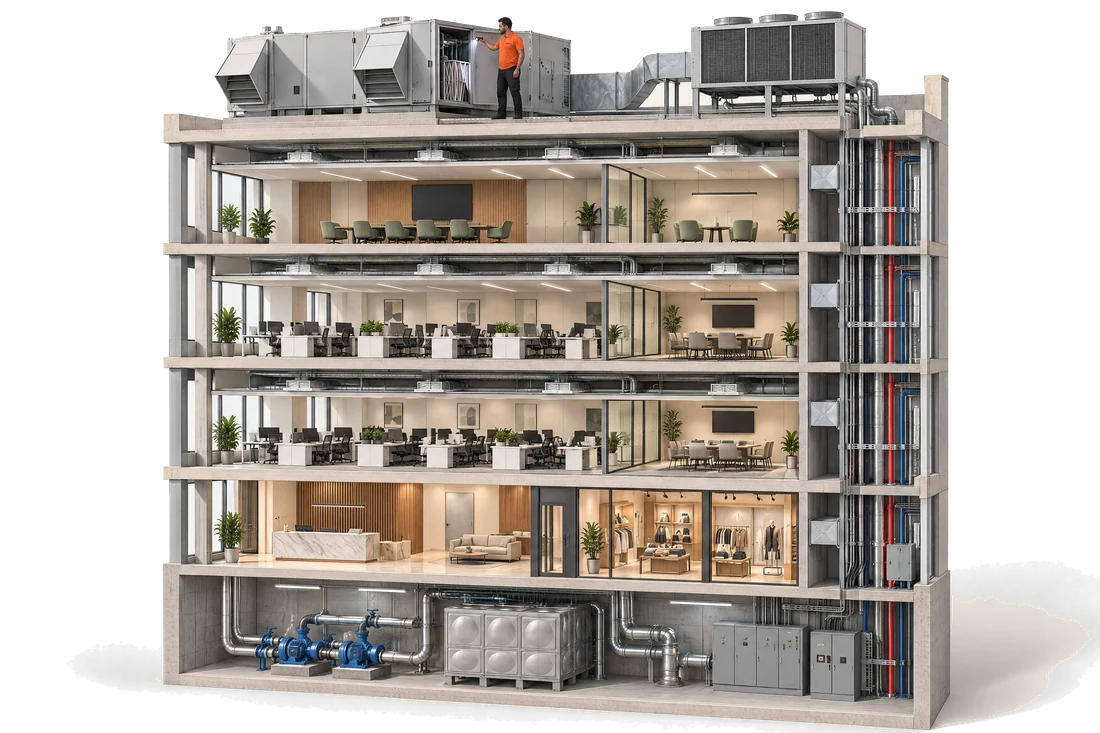
OMEGA’s building AMC is a maintenance programme built from a site survey: an equipment register, planned maintenance of common-area HVAC, electrical, water, drainage and pump systems, fault response, specialist systems coordinated in one service matrix, a site team sized to the building, and records of planned and reactive work, readings and open defects.
The building page has a builder that shows an indicative budget for team posts and specialist lines such as fire systems, lifts, generators and water tanks. These are guide rates; OMEGA confirms the scope, staffing and price after the survey. OMEGA does not issue Civil Defence approvals, cladding assessments or Quality and Safety Certificates, and none of the cases in this guide involved OMEGA.
Questions, answered.
Are these OMEGA case studies?
No. They are public cases drawn from official statements, laws and news reports. None of them involved OMEGA. They are used to show what planned building maintenance is meant to prevent.
What do building maintenance companies in Dubai do?
They maintain a building’s shared systems and areas: cooling, electrical distribution, water supply and pumps, drainage, and often cleaning and site support. Specialist systems such as fire protection, lifts and water tanks are maintained by suitably approved specialists, either directly or under the main contractor’s coordination. Ask which applies to each system.
Is facility management the same as building maintenance?
Facility management is usually wider. It can include cleaning, security, reception, waste and helpdesk services as well as technical maintenance. Building maintenance is the technical part. Many Dubai contracts combine the two, so compare scopes line by line.
How often must water tanks be cleaned in a Dubai building?
Dubai Municipality’s Legionella control guidelines require water storage tanks to be cleaned and disinfected at least twice a year by a Municipality-approved company, and inspected at least monthly. Keep the cleaning certificate and water test results on file.
Who maintains the common areas of a Dubai building?
In jointly owned property, the management entity under Dubai Law No. 6 of 2019, funded by RERA-approved service charges. The owners’ committee checks the work and reviews maintenance budgets, and RERA can order repairs where the common parts are not properly maintained.
What is a building’s reserve fund for?
Law No. 6 of 2019 allows service charges to fund a cash reserve, kept in a separate account, for emergencies and for replacing equipment in the common parts. Outside critical emergencies, it cannot be used without RERA approval. Maintenance records help show what will need replacing and when.
Does a building AMC replace fire inspections or the building safety certificate?
No. A maintenance contract keeps systems working and recorded. Fire safety approvals rest with Civil Defence, and the Quality and Safety Certificate under Dubai Law No. 3 of 2026 depends on a registered engineering firm’s report and the competent authority’s inspection.
Facts checked against
- Dubai Law No. 6 of 2019 on jointly owned property
- Dubai Law No. 3 of 2026 on building quality and safety
- Dubai Municipality: Technical Guidelines for Legionella Control in Water System (V6, 19 August 2025)
This guide is general information, not legal advice.